Cody Lundin & Russell L. Miller & Christopher Marchetti by When All Hell Breaks Loose: Stuff You Need to Survive When Disaster Strikes
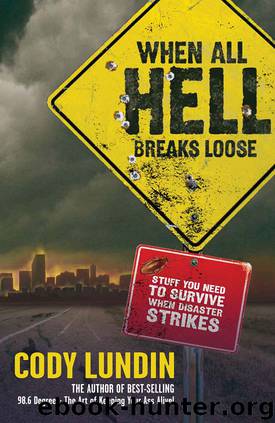
Author:When All Hell Breaks Loose: Stuff You Need to Survive When Disaster Strikes [Strikes, When All Hell Breaks Loose: Stuff You Need to Survive When Disaster]
Language: eng
Format: epub, mobi
Tags: General, Fiction, Emergency Management, Technology & Engineering, Health & Fitness, Reference, Disasters - Psychological Aspects, Nature, Social Science, Survival, Disasters & Disaster Relief, Survival Skills, United States, Natural Disasters, Emergency Management - United States, Natural Disasters - United States, Personal & Practical Guides, Safety
ISBN: 9781423601050
Publisher: Gibbs Smith
Published: 2007-09-20T05:00:00+00:00
What about Eating “Old” Food?
Foods should be thought of in two distinct ways regarding its eventual spoilage. Fresh food has both palatability and nutritional value. While technically all food starts to lose trace amounts of its nutritional value soon after the harvest, it might remain palatable or edible long after most of its nutrition is gone. How much nutrition is lost in foods is dictated by how much nutrition the food had in the first place, how the food was processed, and how it was stored before going home with you from the store. As explained in the junk food section, empty calories are just that. Food devoid of nutrition will leave the body starving for nutrients and you will still feel hungry after eating large amounts of nutritionally empty food. The end result is that a six-month supply of food that’s old will not last six months, as you will eat more of it to remain healthy and “full.”
When the grid goes down, your refrigerator will undoubtedly contain at least some perishable food. Eat the food in the refrigerator first, and then eat from the freezer. Save stored foods until all perishables are eaten. In a well-stocked, well-insulated freezer, foods will usually still have ice crystals in their centers—meaning they are safe to eat—for up to two days. However, use caution. After the 2003 blackout in New York City that left 9 million people without power for up to two days, an increase in diarrhea was linked to the consumption of meat and seafood from homeowners’ unpowered refrigerators.
Nutritional loss aside, most foods will eventually break down until they look, smell, and taste like hell. While it’s impossible for the layman to know how much nutrition a food has lost, even little Johnny is capable of spitting out something that tastes disgusting. Luckily for us and Johnny, food that has lost its palatability is a great clue that it doesn’t contain squat for nutrition either.
Older canned food—provided it’s not bulging or leaky, thus indicating toxicity—can be rotated into a fresher food diet to help extend the fresh food. Think of it as filler that’s much better than the Haitian filler of dough balls that are composed of water, butter, salt, and dirt. One time, I was given a stored five-gallon bucket of brown rice. Upon opening it, I discovered it was horribly rancid. I decided to experiment with this spoiled food and I ate the rice as a normal part of my diet every day until it was gone. Other than having a slightly sour taste in my mouth and fierce flatulence (I was single at the time), I had no problems and went about my extremely active lifestyle as usual. At the time of this experiment, brown rice comprised half of my daily diet. Another time, I failed to rotate a large amount of canned tuna fish and found that many of the cans had slightly swelled up. They were out of date by two or three years. Being
Download
Cody Lundin & Russell L. Miller & Christopher Marchetti by When All Hell Breaks Loose: Stuff You Need to Survive When Disaster Strikes.mobi
This site does not store any files on its server. We only index and link to content provided by other sites. Please contact the content providers to delete copyright contents if any and email us, we'll remove relevant links or contents immediately.
Unwinding Anxiety by Judson Brewer(73421)
The Art of Coaching by Elena Aguilar(53645)
The Fast Metabolism Diet Cookbook by Haylie Pomroy(21256)
Rewire Your Anxious Brain by Catherine M. Pittman(18797)
Healthy Aging For Dummies by Brent Agin & Sharon Perkins RN(17123)
Talking to Strangers by Malcolm Gladwell(13537)
The Art of Thinking Clearly by Rolf Dobelli(10719)
Mindhunter: Inside the FBI's Elite Serial Crime Unit by John E. Douglas & Mark Olshaker(9521)
Crazy Rich Asians by Kevin Kwan(9418)
The Compound Effect by Darren Hardy(9150)
Tools of Titans by Timothy Ferriss(8593)
Periodization Training for Sports by Tudor Bompa(8417)
Becoming Supernatural by Dr. Joe Dispenza(8368)
Wonder by R. J. Palacio(8240)
Bodyweight Strength Training by Jay Cardiello(8029)
Crystal Healing for Women by Mariah K. Lyons(8007)
Change Your Questions, Change Your Life by Marilee Adams(7931)
Nudge - Improving Decisions about Health, Wealth, and Happiness by Thaler Sunstein(7852)
Should I Stay or Should I Go? by Ramani Durvasula(7780)
